
One of the most widespread articles of recent months comes from the world’s most respected newspaper and is about Sweden. Much of the article is, however, distorted – to Sweden’s detriment.
Here is a review of the article’s most serious misunderstandings and inaccuracies.
(This story is originally published in Swedish and can be read here)
This isn’t an easy text to write objectively; there’s an inherent contradiction in being Swedish and wanting to defend Sweden, but the article in the New York Times has such a significant impact on the world’s view of Sweden that there should at least be some nuance. The story has received almost 400,000 Facebook reactions, and despite repeated errors and shortcomings, nothing in the article has been corrected.
Here is a review of the article’s most serious misunderstandings and factual errors.
Claim: The Swedish government chose to conduct an ”open-air experiment” to save the economy.

False. And since this is the overarching premise of the article, it being incorrect is particularly serious: the economy has never been a beacon for Sweden’s choice of strategy. As early as mid-March, Sweden’s state epidemiologist Anders Tegnell explained that “we have always worked very hard to ensure that we have the highest possible level of public health in Sweden. The economy comes second”. Neither the Swedish Government nor Parliament has given a divergent reason for choosing a strategy. The Swedish authorities have repeatedly stated that the reason for implementing a less restrictive strategy is its viability over a prolonged period. (update: The image above is from the printed newspaper, to show this was indeed the overarching premise of the article. If not intended by author, still understood so, even by the newspaper editors.)
Claim: Sweden is hit harder by Covid-19 than the United States

It is true that Sweden, per capita, has had more deaths than the United States (the figure stands at 30 per cent higher, not 40 per cent as the article suggests), but that compares with a US that experienced its corona development later than Sweden. Above all, it compares with a US that’s now seeing an upward trend with regard to deaths. While Sweden has aimed towards creating a sustainable strategy, acceptable to citizens over an extended period of time, the United States has locked down, opened up, and is having trouble getting acceptance on trying to lock down again. In addition, Sweden counts cases of deaths with Covid-19, not only deaths due to the virus. If you have been infected with Covid-19 within 30 days of your death, you are included in the statistics, regardless of the cause of death. Sweden also cross-references the social security numbers of all cases to achieve more trustworthy statistics. In the US, there have been early reports of the death toll being up to 50 percent more than has been reported, and that the country has had huge problems differentiating diagnoses of those who died with or from Covid-19. In addition, Sweden is now back to normal levels of mortality.
Claim: More people died in Sweden compared to other Nordic countries.

True – but Sweden is big. If you instead compare similarly populated regions, the result will be different. One can, for example, compare Själland in Denmark (where Copenhagen is located) with Skåne in Sweden. There’s only a slim stretch of sea between the two regions, but despite that, Skåne has fewer deaths in both absolute and relative numbers. This is the trend in several countries, which is why it is often better to compare regions rather than countries.
Claim: The daily lives of Swedes have continued largely unhindered

It might be easy to believe for those who see Sweden from the outside, but for those of us in Sweden during the pandemic, daily life is largely different. City centers and restaurants have emptied, hundreds of thousands have worked from home and met neither the elderly, risk groups nor even friends. Many have lost their jobs due to disappearing infrastructure, with even more being furloughed. Almost all of this was achieved without new legislation, as the situation was not judged to require it. Legislators limited the number of people allowed to gather (a maximum of 50), and restaurants and other public institutions were given rules of conduct for their activities. Here, it’s important to understand that Sweden has a different political tradition than many other countries – including our neighbors – of having an administrative model where politicians both listen to and trust responsible authorities. While other countries made political decisions, the Swedish Public Health Agency’s recommendations in Sweden became indicative. It stated early on that every decision would have its foundation in science, which meant Sweden stuck to the idea of not shutting down society entirely, and instead introduced a number of recommendations. The recommendations, in turn, led to large numbers of companies closing down, furloughing staff or asking employees to work from home. City centers and destinations were emptied. Self-imposed isolation began in Sweden, where there’s been very little ”business as usual”.
Claim: Denmark and Sweden’s consumption decreased by about the same – despite Denmark being shut down.
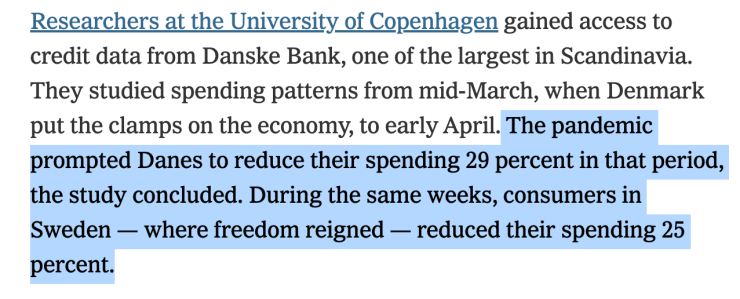
The statement is based on credit card data from Danske Bank and a report written about it. But Danske Bank is not nearly as big in Sweden as it is in Denmark. Nowhere is this mentioned by New York Times. If you look at other reports, one from swedish bank SEB, the picture is completely different. In their report Sweden was the bigger spender, relative to the neighboring countries. Of course, SEB’s report can also be criticized in the same way as Danske Bank. And Nordea in Finland has other data that paints another picture. All this makes it clear how difficult it is to use this data to give a correct view.

***
These are some of the statements in the article that make it both misleading and wrong. And not corrected by the New York Times.
And strangely enough, the reporter himself seems to shrug his shoulders at it. Maybe he had already decided where the text would land, before he wrote it? Because on April 17, he wrote a tweet in which he called Sweden’s strategy a ”crackpot strategy”.
This article is free and accessible with the help of people who contribute financially every month for journalism to be open.
You can also contribute, through the Patreon service.
The article is written under the CC-BY license, free to share and republish if you refer back here.
Update: New York Times reporter has given his response, you can read it here.
Update2: The day before this story was published, the reporter wrote this:
 Journalist. Vinnare av
Bra skrivet om en extremt dålig artikel. Hans svar, punkt för punkt, på den här artikeln är närmast skrattretande. https://imgflip.com/i/47x7sk
Here’s a comment from a Brit in the UK wishing we’d copied you in Sweden. Tegnell has been a real inspiration, proving that civil liberties can be properly protected whil fighting off a pandemic.
Sweden’s the only country that treated its citizens like adults. I prefer Sweden’s strategy.
Another Brit here, saying well done Sweden!
I have just spent a few days in Sweden in Malmo and Göteborg. What a blessed relief it was to arrive at Göteborg Airport after dealing with the mask stasi at Manchester Airport. (Why, uniquely in Europe, are our UK airport staff so incredibly belligerent and charmless?) Apart from there being very few international tourists, Sweden seemed wonderfully normal. Restaurants and shops were full. Life goes on. No masks anywhere until you get to the UK boarding gate. I basked in sanity, soaking it up so that I can take some home with me. Many Swedes I spoke to were worried that they were the pariahs of the world. I reassured them that there many Brits who agree with them. History will prove them right; they must stick to their guns.
In the meantime, I’ve had to fill in a 9 page form of ID and personal details in order to come back into the UK. My goodness, it really feels like I am about to go the wrong way through the iron curtain.
Was on vacation for two weeks near Anderstorp, and ,my god, how relaxing to be surounded by normal people in a normal Country.
Good bless Sverige and Mr. Tignell !
Alles gute aus Deutschland!
I had to escape from Newcastle to Stockholm for 10 days from the last week in May. I felt like a POW escaping to neutral territory. Thank God I made it. I know Swedes have had to take lots of measures and hotel occupancy then was down to 20 percent, so its not plain sailing. However, the feeling of normal life was a paradise – and the fatality rates are overall not as bad as the UK. The lockdown is crazy and lethal. Now there are ridiculous arrows telling me which side of Northumberland Street to walk on and big fat City Council bullies policing pedestrians. It just gets worse and worse. Well done Sweden, don’t give in.
One of the most difficult parts of statistical analysis is comparing apples with apples. It’s hard for statisticians, for untrained NYT journalists, more so. Covid-19 has been shown to have a distinct age and underlying health/mortality relationship. Older people die at a far higher proportion. So: if the authors here wish to compare apples with apples, compare deaths IN AGE COHORTS. Sweden has a higher proportion of elderly than many other countries. So because your age care was better, more people died. The second factor is duration (you touched on this). It’s near impossible to compare to sites totals until it is actually all over. Many countries -New Zealand for example are touted as ’success’ because mortality and infections are low. Well, they’re not. They’re gambling on a effective vaccine. Otherwise, they’re just places that haven’t had the outbreak yet, and could at any time. Other countries, now touted as ’success’ are having second waves, and may have third etc. I’m not saying there were not mistakes made by the Swedes, but realistically you’re over it. That’s not something the US or New Zealand can claim. I hope the lessons of the disease (more ICU, effective isolation and quality care for the elderly) are learned. And I hope that someone does another statistical analysis: comparing the social damage (including early death, suicide, family breakdowns, mental illness and of course financial welfare) caused by the draconian lock-downs and Sweden’s more nuanced approach. I suspect what you lost in Covid-19 mortality is far compensated in those measures
Leaving aside the not insignificant point that “health” of a society is a tad more complex than the measurement of short-term mortality rates, someone might point out to Goodman (and his abysmal ilk) that, far from conducting an experiment, Sweden is pretty much following the approach that has hitherto been standard across the globe as a reaction to any pandemic, viz. to proceed insofar as possible with life as normal, with precautions to limit illness and death where possible. The results of the Covid response in Sweden probably aren’t that different to the likely outcome had COVID swept the country in, say, the 60s – when the rest of the world, not being as enlightened as we are today (and lacking the “benefit” of the internet, possibly the greatest curse to befall mankind) would have responded in much the same way.
The experiment is therefore, in fact, being conducted pretty much everywhere else other than Sweden. “Experiment“ suggests something done for the first time, and to the best of my knowledge, this is the first time in human history, that countries have deliberately terrorised their populations and essentially shut down many critical elements of society, including entire schools systems, non-Covid Health-care and their economies, on which the future well-being of the population depends. It remains to be seen just how damaging this experiment will turn out to have been for those societies in terms of e.g. medium term death rates, psychological trauma etc. but it will far outweigh the trauma caused by the short term rise in mortality experienced in Sweden. And if the virus returns it will be interesting to see whether the experimenters decide to reimpose those same devastating lockdown policies, or will accept that he Swedes got it right, and opt for a more nuanced solution rather than the sledgehammer they’ve used to date.
Regarding comparisons between countries, why does Goodman choose to compare Sweden with Norway and not, for instance, Holland? If it’s because they’re contiguous, how would he explain the difference in rates between France and Germany which, last time I looked, are next door to one another. Explanation of the mortality rate differences between countries requires something more than a superficial analysis based on geographic location or climate. But that’s likely beyond Goodman’s comprehension.
For some perverse reason – that’s very hard to fathom – the English-language leftist media (NYT, Washington Post in the US, the Guardian in the UK, the BBC, Sky etc.) have, from the start, been willing the Swedish (or any non-orthodox) approach to “fail”, and have been determined to demonstrate this in endless dire and tendentious articles such as Goodman’s. I’d swear I could even detect palpable glee when the Swedish mortality rate started to rise.
I believe that any objective Ex-post analysis of this catastrophe will demonstrate that in this they – that element of the media – have been entirely disappointed. If ever I hear of another pandemic approaching, I’m off to Sweden.
Thank you for a well written report on journalism about the Swedish covid-19 response. The bad reporting isn’t only done by Washington Post but by all mainstream media in mainly US. Copy-cat journalism has spread a lot of nonsense.
Since this article was written the pandemic has spread like wildfire all over the world. In sweden we have less ocerdeadliness now than the previous four years, the number of infected have gone down drastically, But not one article about it in CNN WP or other international media. Not one article about how to interpret statistics and problems in comparing Swedish statistics with the rest of the world. Mistakes has been made in Sweden too of course, but time will prove that our reponse have been no less effective than in the rest of the world.
British and US media is incredibly biased!